
The Hidden Cost of Cash: Why Digital Payments Unlock Business Loans for MSMEs
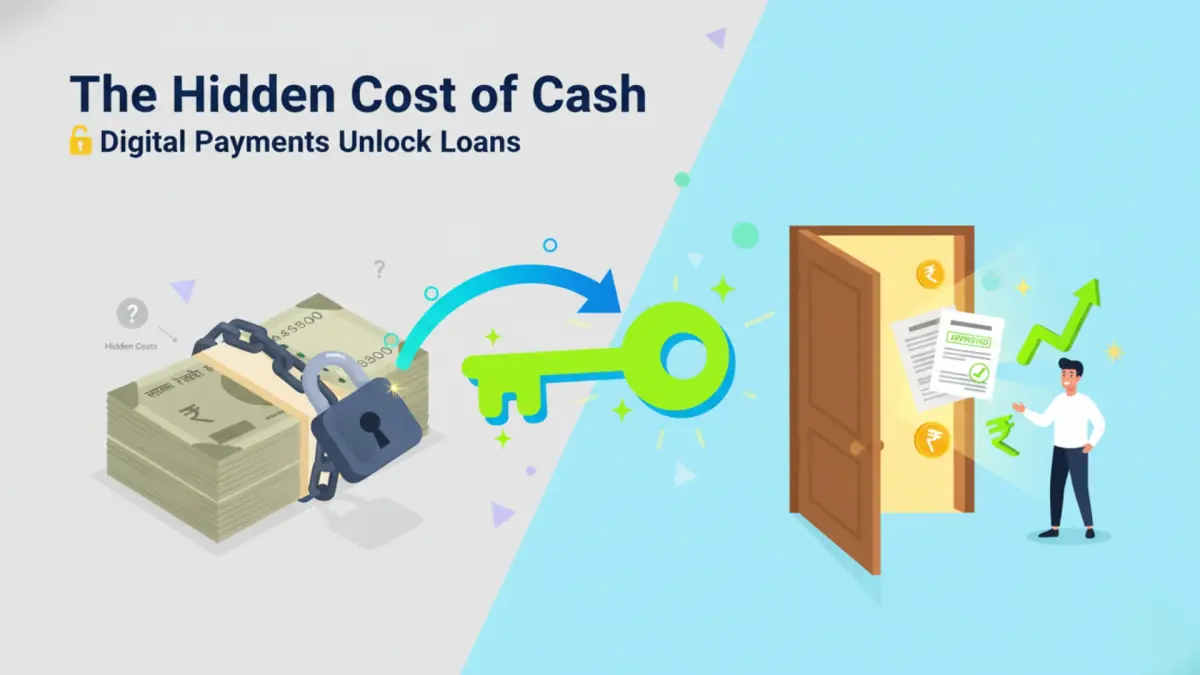
The Invisibility Problem: Why Cash Businesses Can't Get Loans
Cash Creates Invisible Businesses
When MSMEs operate primarily in cash, their revenue never reflects in the formal financial system. Banks can't verify sales, profits, or cash flows—leading to instant loan rejections.
Why Lenders Reject Cash-Dominant Businesses
Lenders rely on verified data, not verbal claims. If your revenue doesn't appear in bank statements or GST returns, lenders treat it as non-existent, no matter how profitable your business actually is.
The Cash Trap
Cash-dependent MSMEs end up borrowing from informal lenders at high interest rates (24–36%). This prevents growth, blocks capital accumulation, and creates a cycle of lifelong credit struggle.
How Digital Payment Data Transforms Credit Assessment
Digital Payments Build Verified Business Identity
UPI, cards, and wallet payments create timestamped, tamper-proof records that lenders trust. Even six months of digital transactions can replace years of incomplete financial statements.
What Lenders See in Your Digital Transaction History
- Daily, weekly, monthly sales patterns
- Revenue consistency
- Number of unique customers
- Seasonality trends
- Ticket-size distribution
- Customer repeat behavior
- Payment timing and settlement cycles
This Enables Cashflow-Based Lending
Instead of collateral or multi-year statements, lenders evaluate your business through real, verified daily transaction flows—making credit accessible even for first-generation entrepreneurs.
The Data Advantage: What Your Transactions Reveal
Every Digital Payment Carries 10+ Data Points
UPI timestamps, amount patterns, customer identifiers, geo-location insights, and payment method diversity tell lenders the true story of your business.
Consistency Signals Credibility
Lenders look for regular digital deposits, stable activity, and transparency. Sudden swings or cash-heavy periods raise red flags.
Integrated Ecosystems Matter
Platforms like Bharatrath link payments with billing, inventory, and analytics—creating deeper operational visibility that lenders reward with higher loan limits.
Real Numbers: Cash vs Digital Credit Outcomes
Digital Businesses Get 3–4X Higher Approval Rates
Digital-payment-first MSMEs enjoy loan approval rates of 60–70%—compared to 20–30% for cash-heavy businesses.
Interest Rates Drop by 4–7%
Cash businesses pay 14–18% interest due to risk perception; digital businesses secure loans at 10–13% with better terms and larger limits.
Loan Amounts Increase Dramatically
Cash-based MSMEs often get only ₹2–5 lakh. Digital-payment MSMEs regularly access ₹10–20 lakh and even higher through cashflow-based lending models.
Beyond Basic Payments: Building a Full Digital Financial Ecosystem
Digital Payments Are Only Step One
Maximum loan eligibility comes from integrated systems combining POS, inventory, GST billing, CRM, and analytics.
Standalone Payment Apps Aren’t Enough
Bharatrath ties payments to stock, invoices, customers, expenses, and financial reports—giving lenders multidimensional confidence.
Operational Maturity Attracts Better Credit
Comprehensive digital data proves professionalism, reduces fraud risk, and allows lenders to issue higher, faster, cheaper loans.
Government’s Digital Credit Push
2025–26 Policies Favor Digital MSMEs
New digital-credit models use UPI and GST transaction flows to evaluate MSMEs—reducing reliance on collateral and paperwork.
Collateral-Free Loan Limits Doubled
CGTMSE increased limits to ₹20 crore, directly benefiting digitally transparent businesses.
State Incentives for Digital Adoption
Maharashtra, Karnataka, and Tamil Nadu offer subsidies, priority lending, and preferred interest rates for MSMEs with 70%+ digital payment usage.
Overcoming MSME Digital Payment Hesitation
Myth: 'Digital Payments Are Expensive'
The real cost is being denied credit. A 2% UPI fee saves 12% interest when you switch from informal to formal loans.
Myth: 'Customers Won’t Pay Digitally'
164 billion digital payments in FY 2024 show India’s customers prefer UPI. Resistance usually comes from business owners, not buyers.
Myth: 'Digital Is Too Technical'
Modern QR and POS systems require zero tech skills. Integrated platforms automate everything.
Myth: 'Digital Means More Taxes'
Visibility increases tax compliance, but access to cheaper, larger loans outweighs the cost many times over.
Implementation Strategy: Transitioning from Cash to Digital
Phase One: Parallel Operations
Start accepting both cash and digital. Display QR codes, encourage usage, and track adoption.
Phase Two: Digital Preference
Train staff, streamline digital transactions, and connect payments with invoices and inventory.
Phase Three: Full Integration
Use platforms like Bharatrath where every sale updates stock, GST, financial analytics, and customer records automatically.
Phase Four: Credit Readiness
After 6–12 months of digital payments, approach lenders with verified, lender-ready data.
The Competitive Advantage of Early Adoption
Supply Chain Access
Larger enterprises now prefer digital-ready MSMEs for procurement and payments.
Customer Expectations
Modern buyers prefer digital—cash-only businesses lose customers and repeat purchases.
Government Tenders
Digital audit trails are now mandatory in many public procurement processes.
Resilience and Efficiency
Digital businesses survive disruptions better and make smarter data-driven decisions.
The Path Forward
The Real Cost of Cash Is Missed Opportunity
Cash businesses lose loans, pay higher interest rates, and miss growth opportunities their digital competitors capture easily.
Digital Transformation Starts Small
A simple QR code begins the journey. Each digital payment is a credit-building data point.
Conclusion
The future belongs to digitally transparent MSMEs. Technology, government policy, lenders, and customers have all shifted. Digital payments aren’t optional—they're essential infrastructure for growth.