
The Account Aggregator Revolution: How Indian Small Businesses Can Share Financial Data Securely
What Exactly Is an Account Aggregator?
A Simple Concept With Revolutionary Impact
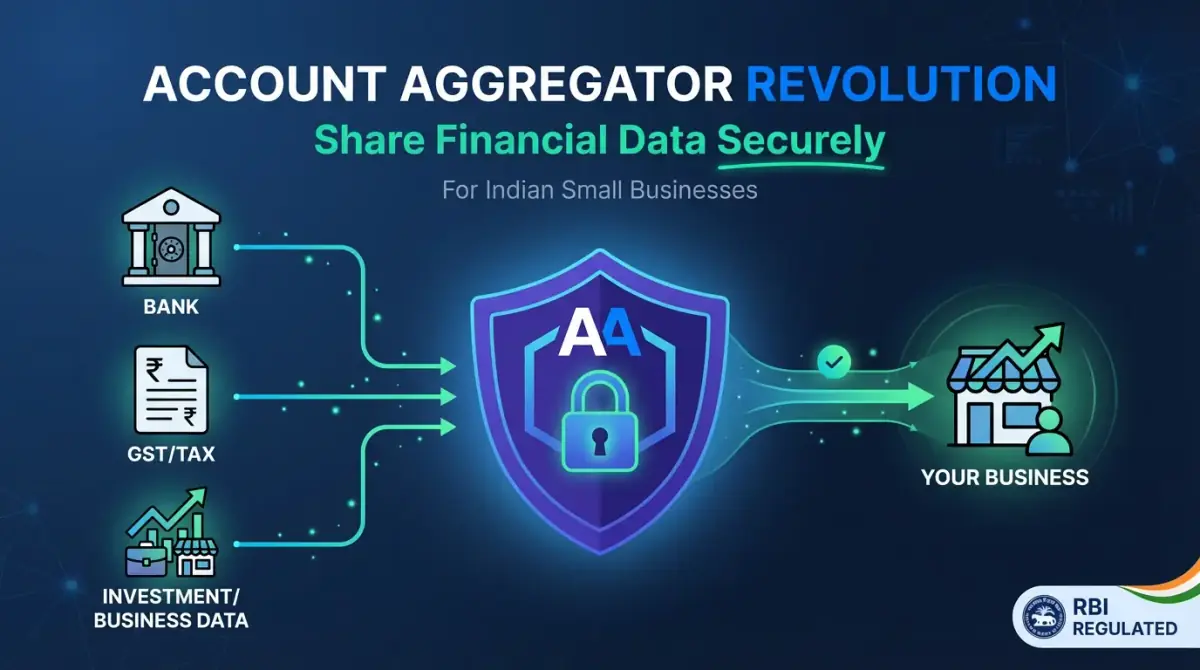
An Account Aggregator (AA) is an RBI-regulated NBFC that allows you to securely share your financial data with lenders or financial services—but only with your consent. It acts as a blind, encrypted courier. The AA never stores or reads your data; it simply transfers it between institutions.
Full Control Over Your Data
You choose what data to share, with whom, for what purpose, and for how long. Consent-based, time-bound access is the cornerstone of the AA framework.
How the Framework Actually Works
Key Participants in the Ecosystem
- FIPs: Banks, NBFCs, insurers, mutual funds, GSTN—holders of your financial data
- FIUs: Lenders, wealth managers, insurers—users of your financial data
- AAs: Regulated intermediaries that facilitate encrypted, consent-based data sharing
The Consent-Based Process
When applying for an AA-enabled loan, you receive a digital consent request specifying data types and duration. After approval, FIPs transfer encrypted data directly to the FIU. The AA never sees the data.
Speed and Efficiency
The entire process—from consent to data transfer—takes minutes, eliminating weeks of physical paperwork and manual verification.
Why Small Businesses Should Care
End of Paperwork-Heavy Loan Applications
No more gathering PDFs, stamped statements, or mismatched documents. Verified data comes directly from source institutions—bank accounts, GSTN, insurers—removing fraud and reducing rejection rates.
Faster Loan Approvals
AA-enabled loans often disburse in hours or days, instead of the traditional 3–6 months. For working capital needs, this speed is transformative.
Visibility for Previously Invisible Businesses
Businesses with limited documentation but strong real cash flow become creditworthy through verified transaction data.
The Security Architecture: Why Your Data Is Safer Than Before
Military-Grade Encryption
Data flows through 2048-bit encrypted channels using TLS protocols. Even the AA cannot decrypt or view the data.
Granular Consent Control
You authorize specific accounts, dates, and data types. Access expires automatically when the consent period ends.
RBI Regulation and Audits
AAs are licensed, audited, and monitored—far safer than emailing PDFs or sharing WhatsApp documents.
Practical Applications Beyond Lending
Cash Flow–Based Lending
Instead of collateral, lenders analyze real cash flows across your accounts. Seasonal and irregular businesses benefit especially.
Invoice & Supply Chain Finance
GST and bank data verify invoices instantly, enabling frictionless supply chain credit.
Financial Planning & Advisory
Advisors can view comprehensive financial pictures—bank, investments, loans—to offer accurate guidance.
Insurance Underwriting & Compliance
Verified revenue and transaction patterns improve premium calculation and reduce compliance burden.
Preparing Your Business for the AA Revolution
Formalize Your Financial Footprint
Maintain proper business bank accounts, file GST consistently, and ensure all financial activity is digital and traceable.
Use Integrated Digital Platforms
Platforms like Bharatrath ensure clean, consistent, GST-linked data across sales, inventory, payments, and invoicing—essential for AA-based lending.
Ensure Data Consistency
Align GST returns, bank deposits, and financial statements. Inconsistencies raise red flags during AA analysis.
Understand and Manage Consent
Read consent requests carefully. Share only what’s necessary and take advantage of time-bound access.
Broader Implications for Financial Inclusion
Democratizing Credit Access
AA shifts evaluation from collateral to performance. Women entrepreneurs, rural businesses, and first-time borrowers benefit significantly.
Tiered Credit Growth
Verified financial behavior builds a trackable record, unlocking higher credit limits over time.
Rapid Ecosystem Growth
Consent volumes grew from 5.5 million (FY23) to 63.75 million (FY24). Over 112 million users are already AA-enabled.
Current Limitations and Future Evolution
Limitations
- Not all institutions fully integrated yet
- Awareness remains low in Tier 2/3 regions
- Traditional banks adopt slower than fintechs
- Businesses with minimal digital footprints need groundwork first
Future Developments
- Integration with UPI, DigiLocker, utility data, e-commerce data
- Cross-border financial data sharing
- Open digital ecosystems for healthcare, education, and government services
Taking Action: Your AA Implementation Roadmap
Step One: Formalize & Digitize
Create a clean digital financial trail through proper banking, GST filing, and integrated platforms like Bharatrath.
Step Two: Download AA Apps
Try licensed AAs (Setu, CAMS, Anumati, PhonePe AA). Learn consent flows and link accounts.
Step Three: Choose AA-Enabled Lenders
Prefer lenders who use AA for faster, data-driven approvals.
Step Four: Start Small
Use AA for personal finance or small loans first to build confidence.
Step Five: Spread Awareness
Encourage other business owners to adopt AA—ecosystem adoption strengthens services and options.
The Competitive Advantage of Early Adoption
Why Early Movers Win
Businesses with clean, AA-shareable data get faster credit, better terms, and inclusion in advanced supply chain finance networks.
Reputation Benefits
Transparent, verifiable data signals professionalism—improving relationships with lenders, suppliers, and corporate partners.
The Bigger Picture: India’s Digital Public Infrastructure
Part of a Larger Revolution
Account Aggregators join Aadhaar, UPI, DigiLocker, and GSTN to create a digital foundation that reduces information friction and democratizes financial access.
Conclusion: From Paperwork to Performance
Final Takeaway
The AA revolution removes barriers that kept millions of businesses out of formal finance. Verified performance now matters more than collateral or paperwork. Early adopters leveraging platforms like Bharatrath to create clean digital footprints will lead in the new data-driven financial era.