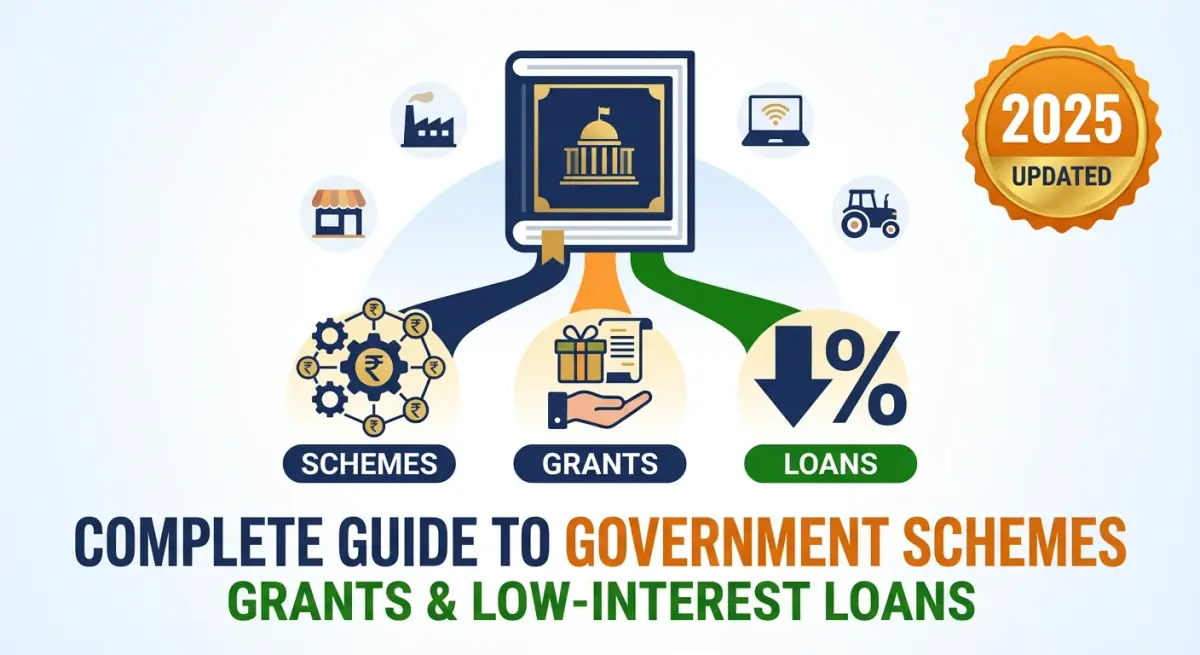
The Complete Guide to Government Schemes, Grants & Low-Interest Loans for Indian Businesses in 2025
Understanding the Government Support Ecosystem
Multiple Agencies, Multiple Opportunities
Government support spans several ministries — MSME, DPIIT, SIDBI, and sectoral ministries. This fragmentation creates confusion but also multiple avenues for funding, subsidies, technology upgrades, and market access.
One Business, Multiple Schemes
A single MSME may qualify for credit guarantees, technology subsidies, startup incentives, export assistance, and employment-linked benefits simultaneously.
Collateral-Free Credit: Breaking the Funding Barrier
Pradhan Mantri Mudra Yojana (PMMY)
MUDRA loans up to ₹20 lakh are available under Shishu, Kishor, Tarun, and Tarun Plus categories. Loans are accessible through banks, NBFCs, and MFIs with interest rates between 8%-12%.
Credit Guarantee Fund Trust for Micro and Small Enterprises (CGTMSE)
CGTMSE provides up to 90% guarantee on loans up to ₹2 crore. For micro-enterprises up to ₹5 lakh, coverage is 85%, encouraging banks to lend without collateral.
Why It Works
Banks reject not due to creditworthiness but lack of security. CGTMSE shifts this risk, dramatically improving approval chances.
The Startup India Ecosystem: Beyond Traditional Business Support
DPIIT Recognition Benefits
- 100% income tax exemption for 3 years
- Angel tax exemption
- Capital gains exemptions
- Self-certification for select labour and environmental laws
Intellectual Property Support
80% rebate on patent filing fees, expedited examinations, and free IP facilitation services funded by the government.
Startup India Seed Fund Scheme
Up to ₹20 lakh for proof of concept and ₹50 lakh for market entry via accredited incubators.
Technology Upgradation and Quality Enhancement
Zero Defect Zero Effect (ZED)
Supports energy-efficient, sustainable manufacturing practices with audits, consultancy, and subsidies. ZED-certified MSMEs gain procurement advantages.
Credit Linked Capital Subsidy Scheme (CLCSS)
Provides 15% upfront subsidy on technology upgrade investments. Equipment purchases for modernization become significantly more affordable.
Market Access and Expansion Support
Market Access Initiative (MAI) Scheme
Supports participation in international trade fairs, buyer-seller meets, and export promotion activities through subsidies.
RAMP Programme
Provides training, digital marketing support, export documentation assistance, and market linkages.
Government Procurement Benefits
- 25% mandatory MSME procurement
- 4% reservation for SC/ST-owned MSMEs
- 3% for women-owned MSMEs
- Startup exemptions from experience/turnover requirements
Employment Generation and Social Entrepreneurship
Prime Minister’s Employment Generation Programme (PMEGP)
Credit-linked subsidies up to 35% for new micro-enterprises. Manufacturing projects up to ₹50 lakh and service projects up to ₹20 lakh are eligible.
Stand-Up India Scheme
Loans between ₹10 lakh and ₹1 crore for women and SC/ST entrepreneurs for greenfield enterprises.
Green Financing and Sustainable Business Support
MSE Green Investment & FIT Scheme
Concessional loans and credit guarantees for adopting energy-efficient or environmentally friendly technologies.
Why Sustainability Pays
Green-certified businesses gain advantages in procurement, corporate supply chains, and consumer preference.
Sector-Specific Initiatives
SFURTI
Supports bamboo, khadi, pottery, honey, and traditional industries by developing clusters with shared infrastructure and marketing support.
KVIC Schemes
Includes concessional credit, market development assistance, and artisan training programs.
Technology Upgradation Fund Scheme (TUFS)
Targets textile & garment sector modernization with interest subsidies and capital support.
Preparing Your Business to Access Government Schemes
Register on All Mandatory Portals
Udyam for MSMEs, DPIIT for startups, JanSamarth for scheme applications, and sector-specific portals for targeted initiatives.
Strengthen Financial Documentation
GST returns, bank statements, audited financials, and consistent digital records are essential for approval.
Create Strong Project Reports
Capital-intensive schemes require formal project reports covering rationale, projections, and outcomes.
Understand Scheme Requirements
Each scheme has specific eligibility criteria. Incomplete or mismatched applications lead to rejections.
Maximizing Benefits Through Strategic Stacking
How to Combine Schemes
Use CGTMSE for collateral-free credit, CLCSS for technology upgrades, ZED for sustainability credentials, and RAMP for market access—each supporting different business needs.
Plan Your Timeline
Obtain registrations and certifications before applying for relevant schemes to maximize approval chances.
Common Pitfalls and How to Avoid Them
Frequent Mistakes
- Incomplete documentation
- Missing application deadlines
- Incorrect or inflated claims
- Not checking updated scheme guidelines
- Applying for unsuitable schemes
The Future of Government Business Support
Emerging Trends
- Digital-first applications & approvals
- Performance-linked incentives
- Data-driven eligibility assessment
- Sector-specific deep interventions
Taking Action: Your Next Steps
Your Practical Roadmap
Register your business, audit your documents, identify relevant schemes, build relationships with implementing agencies, invest in proper digital systems, and follow up persistently.
The Real Opportunity
More Than Funding
Government schemes provide validation, credibility, market access, supply chain entry, and long-term growth opportunities. The businesses that will thrive are those that leverage government support strategically.
Final Insight
Operational readiness and comprehensive digital records are the foundation. Platforms like Bharatrath enable businesses to maintain the documentation and transparency needed to unlock government schemes at scale.