
Why Lenders Love GST Data—And How Your Business Can Use It to Get Funded
The Traditional Lending Problem
Why Old-School Lending Failed MSMEs
Traditional loans required years of audited statements, collateral documents, and complex paperwork—creating delays of months with high rejection rates. This system worked for large corporations, but not for small business owners managing daily operations with limited resources.
India’s Massive Credit Gap
Despite 6.3 crore MSMEs, formal credit access remains limited. The MSME credit gap exceeds ₹20 lakh crore, largely due to inability to prove profitability—not lack of actual performance.
Why GST Data Changed Everything
India's First Fully Verified Business Dataset
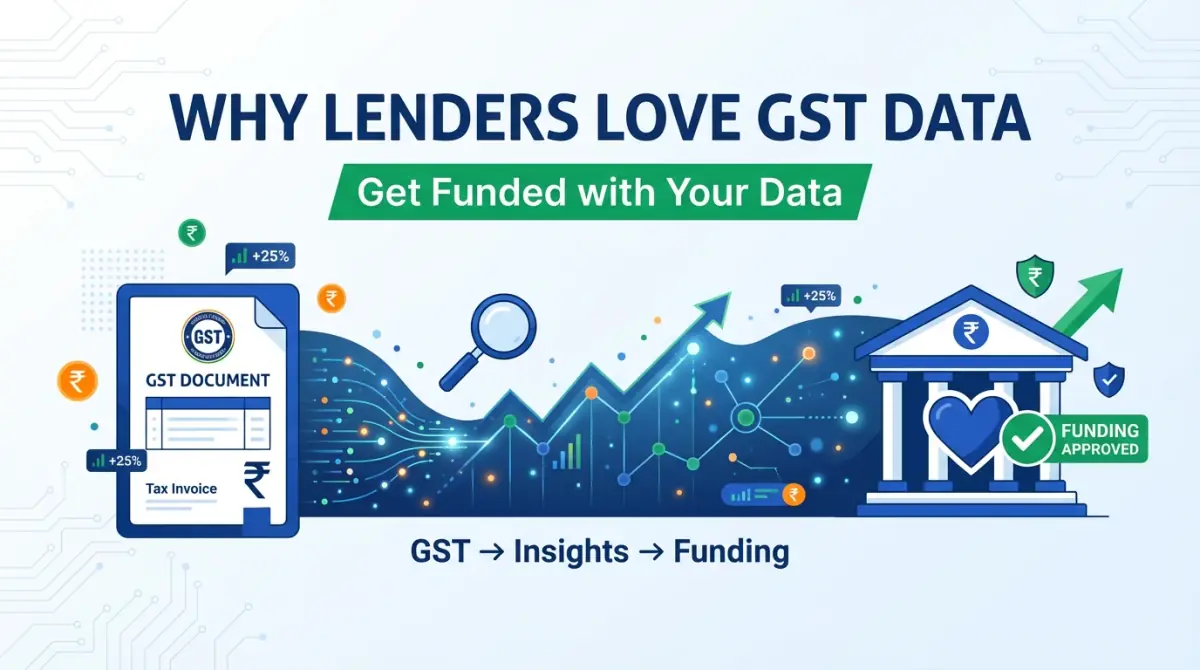
GST created a government-verified, invoice-level record of business activity. For lenders, this became far more trustworthy than self-declared financial statements or collateral documents.
What Lenders Can See From Your GST Returns
- Verified revenue streams
- Business stability and filing discipline
- Actual cash flow patterns
- Input tax credit trails and supply chain strength
- Customer diversification
- Seasonal trends and multi-year performance
The Account Aggregator (AA) Revolution
How AA Unlocks GST Data for Lending
The RBI added GSTN to the Account Aggregator framework, allowing you to securely share verified GST data with lenders through consent-based digital approval. No PDFs, no physical documents—just instant, secure data sharing.
Real Impact of AA Framework
Over ₹20,000 crore in loans has already been disbursed through AA. Nearly 40% of these loans went to small businesses, proving the model’s effectiveness in unlocking credit access.
How Lenders Use Your GST Data
What Happens Behind the Scenes
Lenders fetch your GSTR-1 and GSTR-3B data through AA, then analyze:
- Revenue trends
- Filing consistency
- Customer concentration risk
- Input-output alignment
- Cash flow stability
- Anomalies and gaps
This generates a credit score based on real data—not subjective judgment.
Faster, Data-Driven Approvals
Loans that once took months are now approved in hours or days, often without collateral.
The Business Advantage: GST-Based Lending Benefits
Why GST-Based Lending Is a Game Changer
- Fast approval: 48–72 hours
- No collateral required
- Loan amounts match real repayment capacity
- Customized loan terms
- Builds strong credit history
- Lower borrowing costs
Preparing Your Business to Leverage GST Data
File Consistently and On Time
Regular GST filing signals reliability. Irregularities instantly hurt your creditworthiness.
Maintain Accurate Records
Discrepancies between GSTR-1 and GSTR-3B raise red flags. Clean data builds trust.
Digitize Operations for Accurate Reporting
Systems like Bharatrath ensure your GST returns match real business activity through integrated billing, inventory, and analytics.
Diversify Customer Base
Excessive dependence on a single customer increases lending risk. Diversification improves credit scoring.
Optimize Input Tax Credit
Consistent ITC claims reflect operational maturity and supply chain strength.
Understand Your Own Data
Review your GST filings as if you were the lender. Fix weaknesses before applying.
What Lenders Are Really Evaluating
Deep Insights Lenders Extract from GST Data
- Revenue quality and ITC-linked buyer credibility
- Payment discipline and collection cycles
- Margin structures revealed through input-output ratios
- Compliance attitude
- Multi-year growth trajectory
The Limitations and Realities
What GST-Based Lending Cannot Solve
- Requires at least 12 months of GST history
- Cannot compensate for declining performance
- Loan sizes may be capped
- Not all lenders have adopted this model
The Future of GST-Based Lending
What’s Coming Next
- Proactive pre-approved credit offers
- Dynamic credit limits based on real-time GST data
- Sector-specific lending models
- Deeper integration with payment and e-commerce data
- Lower cost of capital as risk models mature
Taking Action
How to Start Using GST as a Funding Tool
Review your last 12–18 months of GST filings with a lender’s mindset. Invest in digital systems to eliminate discrepancies. Research lenders who use GST-based evaluation. Use the Account Aggregator framework for faster processing.
The Bigger Picture
Why GST Data Is Your New Financial Identity
GST turned millions of informal businesses into verifiable financial entities. GST compliance is no longer a burden—it is strategic infrastructure that determines how quickly and affordably you access capital.
Final Insight
Your GST returns are not tax paperwork—they are your gateway to growth capital. Platforms like Bharatrath ensure your business data stays clean, consistent, and lender-ready.