
Beyond Profit: How Small Businesses Can Access Government Grants, CSR Funds and Social Venture Capital
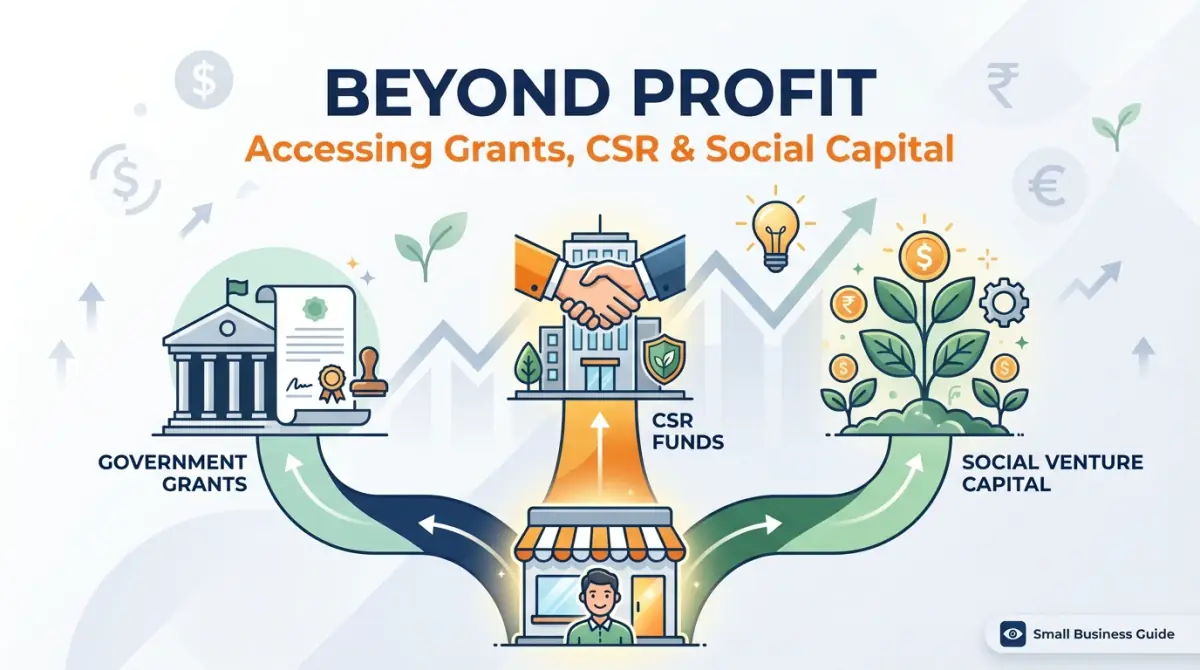
Understanding the CSR Landscape
India’s CSR Mandate
Under Section 135 of the Companies Act (2013), companies meeting certain financial thresholds must spend 2% of their average net profits on CSR. This mandate applies to thousands of companies across India, creating enormous funding potential.
CSR Isn’t Just for NGOs
While CSR funds often go to NGOs, companies can also fund for-profit social enterprises—any business delivering measurable social impact with financial sustainability.
Who Really Qualifies for CSR Funding?
Eligible Impact Areas
- Education & skill development
- Healthcare & preventative health
- Rural development & agriculture
- Environmental sustainability
- Women empowerment
- Employment for marginalized communities
What Companies Want
CSR teams look for measurable impact, clear documentation, sustainable models, and alignment with their CSR focus areas.
The CSR Application Process: From Invisible to Irresistible
Document Your Social Impact
CSR teams demand data—jobs created, environmental improvements, beneficiaries served, and measurable KPIs. Vague claims are immediate disqualifiers.
Align With Corporate Priorities
Study a company’s CSR report and tailor your proposal to match their focus—education, sustainability, women empowerment, etc.
Build Credibility Through Digital Records
CSR funding requires due diligence. Companies expect professional financials, transparent operations, and digital documentation—areas where platforms like Bharatrath help small businesses shine.
Create a Compelling Proposal
Your proposal must include a problem statement, your solution, measurable KPIs, budget breakdown, timeline, team background, and expected impact.
Leverage Multiple Channels
Use platforms like csrbox.org, India CSR Portal, LinkedIn networking, CSR events, and relationships with implementing agencies to reach decision-makers.
The Rise of Social Venture Capital
What Makes Social VC Different?
Unlike CSR which funds projects, social venture capital invests equity in businesses that blend profit with purpose—high-growth models that scale impact alongside revenue.
Sectors Attracting Social VC
- Affordable healthcare
- Sustainable agriculture
- Financial inclusion
- Clean energy & climate solutions
- Edtech for underserved markets
- Affordable housing & sanitation
What Social VCs Actually Look For
Dual Bottom Line
Clear articulation of financial returns + social impact outcomes. Investors want profit and purpose together.
Scalability With Impact
Impact must grow as the business scales—no mission drift.
Strong Leadership With Purpose
Social VCs invest in founders with commitment, credibility, and values-driven leadership.
Measurable Impact Metrics
Track KPIs like jobs created, communities served, carbon reduction, financial inclusion metrics, etc.
Unit Economics That Work
Impact doesn’t excuse poor business fundamentals. Social investors still expect sustainable unit economics.
Notable Social VC Firms in India
Leading Impact Investors
- SIDBI Venture Capital Limited
- Caspian Impact Investment Adviser
- Acumen
- Mumbai Angels (social vertical)
- SVP India
Preparing Your Business for Impact Funding
Formalize Your Impact Measurement
Track beneficiary data, employee demographics, environmental metrics, retention rates, and other measurable KPIs.
Strengthen Your Digital Infrastructure
Impact investors expect professional records—financial statements, inventory management, payroll data, compliance reports, and transparent operations.
Build Your Narrative
Combine hard data with human stories—testimonials, case studies, and community impact evidence.
Ensure Regulatory Compliance
CSR funding requires proper registration and tax compliance. Social VC typically requires a private limited structure.
Develop Strategic Partnerships
Collaboration with panchayats, government bodies, or NGOs strengthens your credibility and accelerates approvals.
The Funding Reality Check
What These Funds Are NOT
CSR isn’t venture capital—funds support specific, measurable projects. Only ~5% can be used for admin expenses. Social VC isn’t easy money—investors expect strong business fundamentals.
Funding Timelines
CSR cycles may take 6–12 months. Social VC fundraising may take even longer, especially for first-time founders.
When Impact Funding Makes Sense
When You Should Pursue Impact Capital
Impact funding is ideal when your business model inherently creates social value, needs patient capital, or aligns with CSR priorities that offer long-term partnerships and credibility.
The Strategic Advantage
More Than Just Money
Access to CSR or social VC builds operational discipline, strengthens culture, boosts brand reputation, attracts talent, and opens new networks and partnerships.
Making Your Move
Your Action Plan
Audit your social impact. Digitize your operations. Document everything. Identify aligned CSR priorities and social VCs. Present clear financials, strong impact metrics, and measurable KPIs.
Final Guidance
The funding exists—and the mandate exists. The question is whether your business has the digital transparency, documentation, and impact clarity needed to access it.
Explore how platforms like Bharatrath help small businesses build the digital foundation required for CSR and social VC funding.